


Albert John
BREWSTER
1925 - 1945

Early Life
ALBERT JOHN BREWSTER (known as ‘JOHN’) was born on the 19 July 1925 in Great Waltham, the fourth of seven children, and the second eldest son of David and Alice Mary Brewster (née Matthams), who were married at Great Waltham Parish Church on the 8 May 1909.
David and Alice's firstborn was Elsie May, b. 8 Oct 1914, another daughter followed, Margaret Ethel, who was b.29 March 1917 and then their first son, Charles David was born on the 23 December 1919. Doris Nell, was b. 1922 and following Albert’s birth, Frederick Marcus, b.14 Dec 1926 and Joan Frances, b. Mar 1932. The family lived at Lake View Cottages, Minnow Mead. Great Waltham.
His father, David was a Hay binder at the time of his marriage and when Albert was born, his father was a farm labourer.
Albert was baptised in the village church on the 9 August 1925 and he attended the local village school.
BAPTISM OF ALBERT JOHN BREWSTER
PARISH CHURCH, GREAT WALTHAM, 9 AUGUST 1925
There is one record of Punishment in the School records of 'talking in Assembly' and after a verbal warning in May 1938, when he was 12 years old, he was given four strokes of the cane on his hand by G C Hyde, a teacher.
Military Life
Albert, known as John, enlisted as a Private in the 8th Battalion, The Royal Scots Regiment, (The Royals Regiment),
Service No. 14733428 in about 1941, when he was 16 years old. The Royal Scots was a Territorial Force.
The 8th Battalion was one of four newly formed Battalions of the Kings own raised on the 2 August 1939, as a second-line duplicate of the 7th/9th Battalion. Initially they remained in the UK as part of the 44th Lowland Infantry Brigade, which was part of the 15th (Scottish) Infantry Division. This Division gained a strong reputation during the war for its effectiveness in combat.
In February 1944, Operation Veritable (known as The Battle of the Reicshwald) was the code name for the operation which would clear the Germans from the ground between the parallel rivers of the Maas and the Rhine and drive them back over the latter.Tnis was the longest continuous period of action by the 8th Battalion lasting 10 months in North-West Europe from June 1944 to April 1945.
The 51st Highland Division formed part of the 1st Canadian Army offensive. The attack was faced with three lines of defence, the first a line of anti-tank ditches, defended farms and villages a mile or more deep; the second was an area of open ground in the north of the Siegfried Line which itself ran south through the Reichswald forest to Goch; and six miles further back was a second line named by Montgomery as the Hochwald "lay-back".
Albert served in the Western Europe Campaign in 1944 and was a Bren-Gunner. The job of Bren-Gunner was always given to a good shot and someone with initiative and plenty of savvy to operate under great pressure either during defence or in a skirmish or an attack. The rifle section would be commanded by a Corporal and there would be a Lance-Corporal as second-in-command. There was one Bren Gun in each Section and the Lance-Corporal would take charge of it along with a Bren Gunner and someone who assisted the Bren Gunner. Being a Bren Gunner meant you would operate in that small team of three.
The 8th Battalion was part of the 44th Brigade. The operation started as an infantry frontal assault, with armoured support, against prepared positions, in terrain that favoured the defenders.
On 7 February more than 750 RAF heavy bombers deluged Kleve and Goch with high explosives. In order to reduce the defenders' advantages, a large scale artillery bombardment was employed, the biggest British barrage since the Second Battle of El Alamein. Men were literally deafened for hours by the noise of 1,034 guns. It was hoped that this would not only destroy the German defences throughout the Reichswald but also destroy the defenders' morale and their will to fight. Air raids were also undertaken to isolate the battle area from further reinforcement.
Operation Veritable began on 8 February 1945. At 10:30 five infantry divisions, 50,000 men with 500 tanks, attacked in line – respectively from the north, the 3rd and 2nd Canadian, the 15th (Scottish) in the centre and the 53rd (Welsh) and 51st (Highland) on the right. The next day the Germans released water from the largest Roer dam, sending water surging down the valley, and irreparably jammed the sluices to ensure a steady flow for many days. The next day they added to the flooding by doing the same to dams further upstream on the Roer and the Urft. The river rose at two feet an hour and the valley downstream to the Maas stayed flooded for about two weeks.
This flood forced the U.S. soldiers to postpone their assault. The Canadian and British forces had to go it alone. From the outset of the offensive, bad weather complicated Allied operations. General Horrocks, commanding the British forces, later said of the battle: “What was so maddening was that the whole thing could have been so easy if only the frost had continued”. A thaw turned the previously frozen ground into a quagmire, a situation that was aggravated by continuous rain and the fact that the German army had breached the banks of the Rhine. The Allies advanced slowly and were unable to fully exploit their superiority in numbers and equipment.
In the words of the Allied Supreme Commander general Dwight D. Eisenhower: Operation Veritable “was some of the fiercest fighting of the whole war […] a bitter slugging match” between Allied and German forces.
Death & Memorial
On the 19th February 1945 Albert (John) and his unit were tasked to capture a certain objective inside the town of Goch. In their path lay a railway goods yard, with a number of smashed railway trucks on the lines. Under cover of darkness, they advanced across the rails. John, as Bren-gunner, was on the left of the line of men.
A voice challenged them as they reached the trucks and when they answered they were fired on. Three German machine guns placed to cover the yard opened fire. There was little cover, so they had to retreat across the rails, about 100 yards, to get cover. They also needed some covering fire to keep the enemy occupied whilst they got back.
Without being asked, Albert did that. He emptied his machine gun at the Germans, saving the lives of his comrades in the process and in doing so, lost his life.
He was 19 years of age.
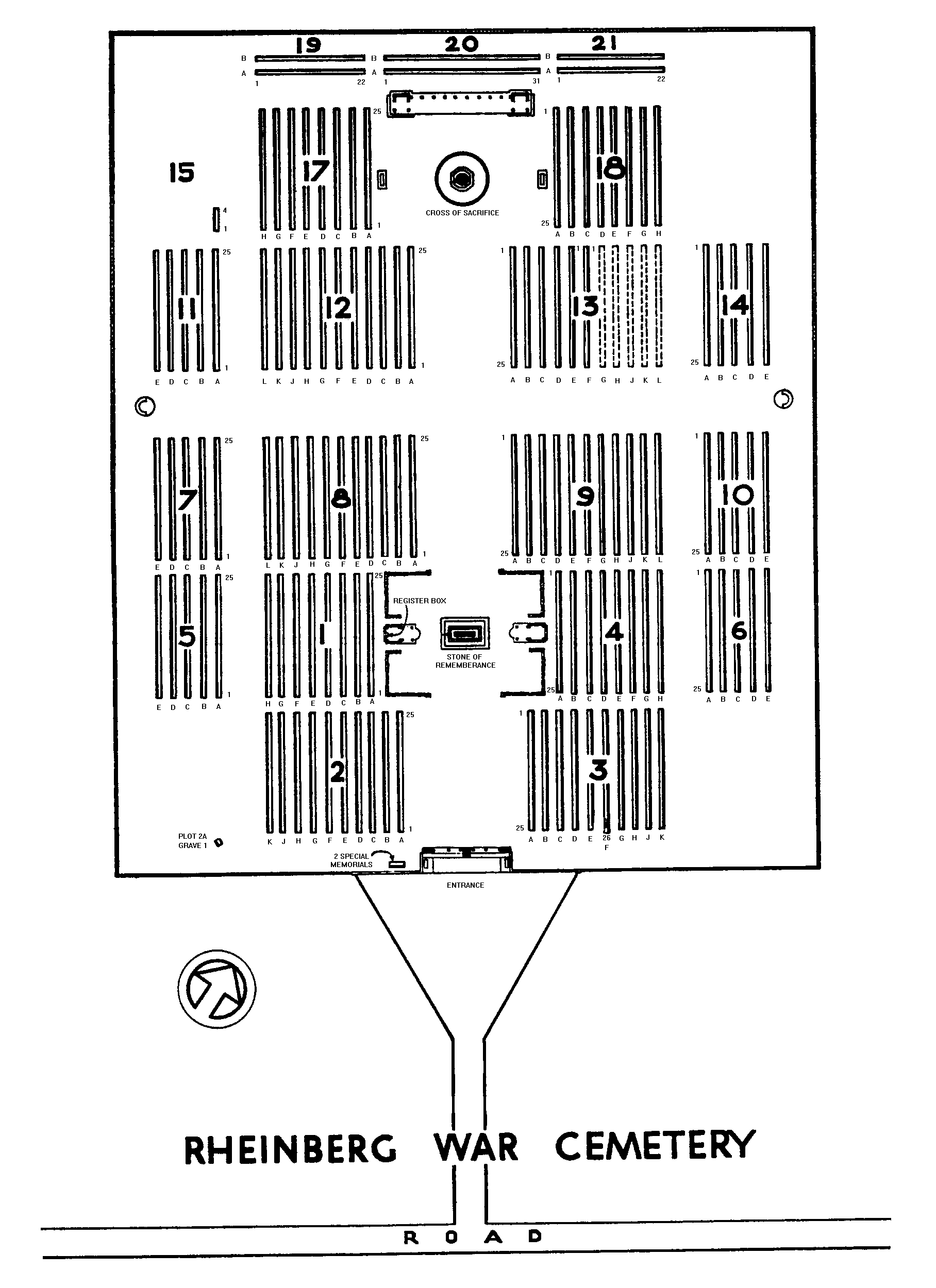
Albert was buried just on the outskirts of Goch. In April 19946, Rheinberg War Cemetery was chosen by the Army Graves Service for the assembly of Commonwealth graves recovered from numerous German cemeteries in the area.
Albert was reburied here on the 2 July 1946.
Plot 12, Row E. Grave no. 6.



CHELMSFORD CHRONICLE
18 MARCH 1945

Albert John is also remembered on the Great Waltham War Memorial.